
58Chapter 58 of 74
Where Is the Robot? Local and Global Localization
Introduction
The tf2 library is now part of the toolbox: it keeps track of every frame and every transform between them. With it we can start to answer one of the most important questions in mobile robotics: where is the robot?
The goal is to estimate, at any moment in time, the position of the robot from the information its sensors give us. This problem is called localization. In this chapter the problem is set up with reference frames and transforms, and split into two smaller problems that are easier to solve.
Three reference frames
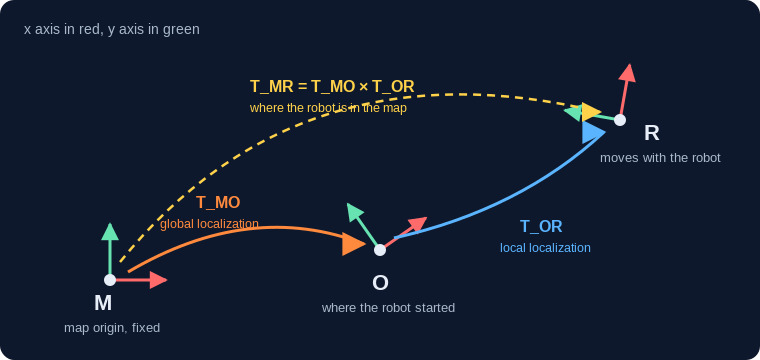
We keep the ROS 2 convention for describing the position of a robot in a two dimensional space, and define three reference frames:
| Frame | What it marks | Does it move? |
| R | The robot itself. It is attached to the robot and moves along with it. | Yes, with the robot |
| O | The initial position of the robot: the place where the motion started. | No |
| M | A fixed point of the map that is taken as its origin, the centre of the map. | No |
Localization as a chain of transforms
With these three frames, the localization problem becomes the calculation of two transformation matrices:
- T_OR: the transform that connects the frame O with the frame R, so where the robot is compared with its starting point.
- T_MO: the transform that connects the frame M with the frame O, so where the starting point is in the map.
Once both are known, we only have to compose them, which means multiplying them, to get the overall transform that connects the frame M to the frame R. That transform is the answer to the question "where is the robot?"
T_MR = T_MO × T_ORBreaking the problem in two
As always with a complex problem, we can break it down into smaller and easier sub problems, solve them separately and then combine the results to solve the original problem. This is also the classic way to approach localization in robotics.
Instead of trying to find the relationship between M and R directly, and so the pose of the robot in the map, we first find the pose of the robot relative to its starting point.
Local localization
Finding the relationship between the frame O and the frame R, so the transform T_OR, is called local localization. It answers: how far and in which direction has the robot moved since it started, and how much has it turned?
Global localization
Based on that, we can then work out where the starting point of the robot is in the map, the transform T_MO. Composing it with T_OR gives the transform between M and R, and so the position of the robot in the map. This is called global localization.
| Local localization | Global localization | |
| Transform | T_OR (O to R) | T_MO, and with it T_MR (M to R) |
| Question it answers | Where is the robot compared with where it started? | Where is the robot in the map? |
| Needs a map? | No | Yes |
Drive the same path from three different starting points below. The local pose is identical every time, while the pose in the map depends on where the robot started.
The next chapters focus on the first problem, local localization: strategies to give an accurate estimate of the position of the robot relative to its starting point. Global localization, finding the robot in a map of its environment, belongs together with mapping and is a topic of its own.