


Avionics (Teknofest Rocket Competetion)
For the Teknofest International Rocket Competition, we developed a dual-redundant avionics system for a sounding rocket. The objective was to build a flight computer capable of logging sensor + GPS data, detecting apogee autonomously triggering parachute deployment (pyro activation), and sending telemetry to the ground station.
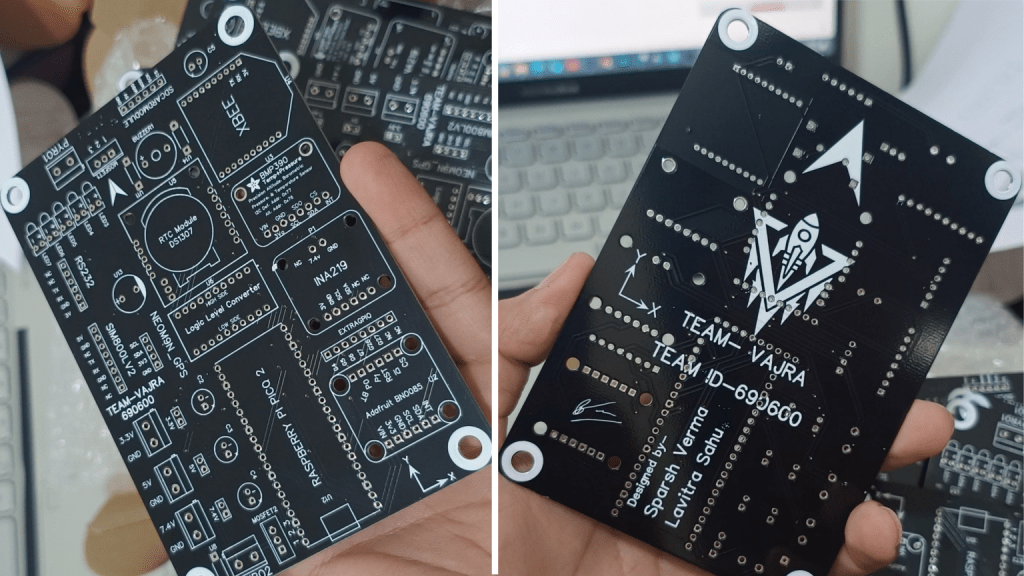

Project Overview
The competition required two independent flight controllers for safety:
| Flight Controller | Purpose | Notes |
| Primary Flight Computer (Custom PCB) | Real-time sensor fusion, telemetry, data logging, pyro deployment | Designed & developed by our team from scratch |
| Secondary Flight Computer (Backup) | Redundant apogee detection + backup pyro trigger | EasyMini Altimeter (Teknofest recommended safety module) |
We cleared all documentation and review rounds, but could not reach the final launch stage due to logistics (covered here:- Teknofest Insights ).
Hardware Architecture (Primary Flight Computer)
The custom PCB integrated the following modules:
| Component | Function |
| Raspberry Pi Pico 2 (RP2040) | Main microcontroller — handles sensor fusion & data logging |
| BNO085 (IMU) | Quaternion + acceleration readings used for apogee detection |
| BMP390 (Barometric sensor) | Altitude estimation using high-resolution pressure drop |
| INA219 (Power monitor) | Battery voltage & current measurement for power safety |
| NEO-M9N GPS | Flight tracking + landing location after descent |
| SIM800L V2 (GSM backup) | Sends SMS with last known GPS location if XBee fails |
| XBee 3 Pro (Telemetry) | Real-time long-range wireless telemetry to ground station |
| IRFZ44N MOSFETs (x2) | Pyro deployment channels: drogue + main parachute |
| DS1307 RTC | RTC timestamps for each logged event during flight |
| SD Card module | Stores flight events and sensor logs at 100 Hz |
| Level shifters & Protection circuits | Isolates 5V / 3.3V domains and protects Pico MCU |
| Buzzer & LED indicators | Pre-launch, arming, and status feedback |
Diagrams


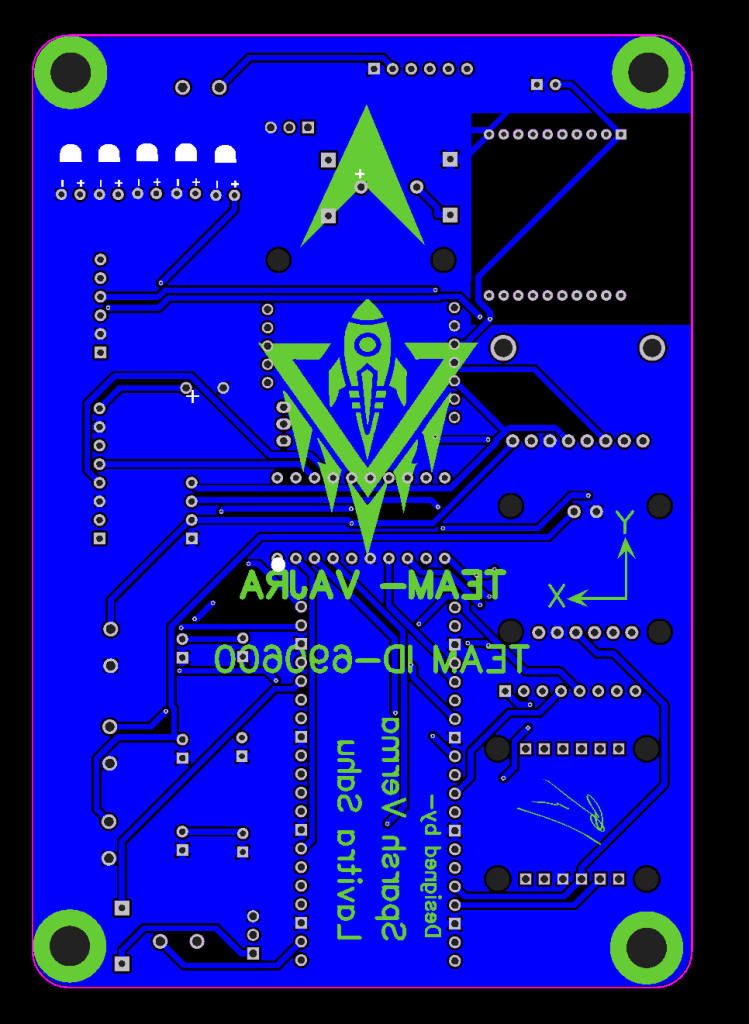


Working
Teknofest Insights
My Learnings
- Learned how to design a full avionics PCB (from schematic → routing → Gerber → manufacturing).
- Understood how to integrate multiple sensors (IMU + barometer + GPS + INA219) into one system.
- Gained experience in sensor fusion (IMU + barometer for apogee detection).
- Learned how to create dual-redundancy architecture (primary flight computer + secondary EasyMini).
- Designed pyro-deployment circuits (MOSFET + safety interlocks).
- Learned importance of ground testing before integrating in rocket body.
- Understood telemetry systems (XBee long-range + GSM fallback using SIM800L).
- Learned how to log flight data at high sampling rate (100 Hz) to SD card with timestamps.
- Realized how critical power budgeting & noise isolation is (5V/3.3V domains, level shifting).
- Improved skills in documentation, failure-reporting, and presentation for competition rounds.